Monthly Climate Summary: August 2026
Provided by the State Climate Office of Ohio, a collaboration of the Byrd Polar and Climate Research Center, Geography Department, and OSU Extension with support from Power A Clean Future Ohio

Subscribe to the Monthly Ohio Climate Summaries and Outlooks
Temperature
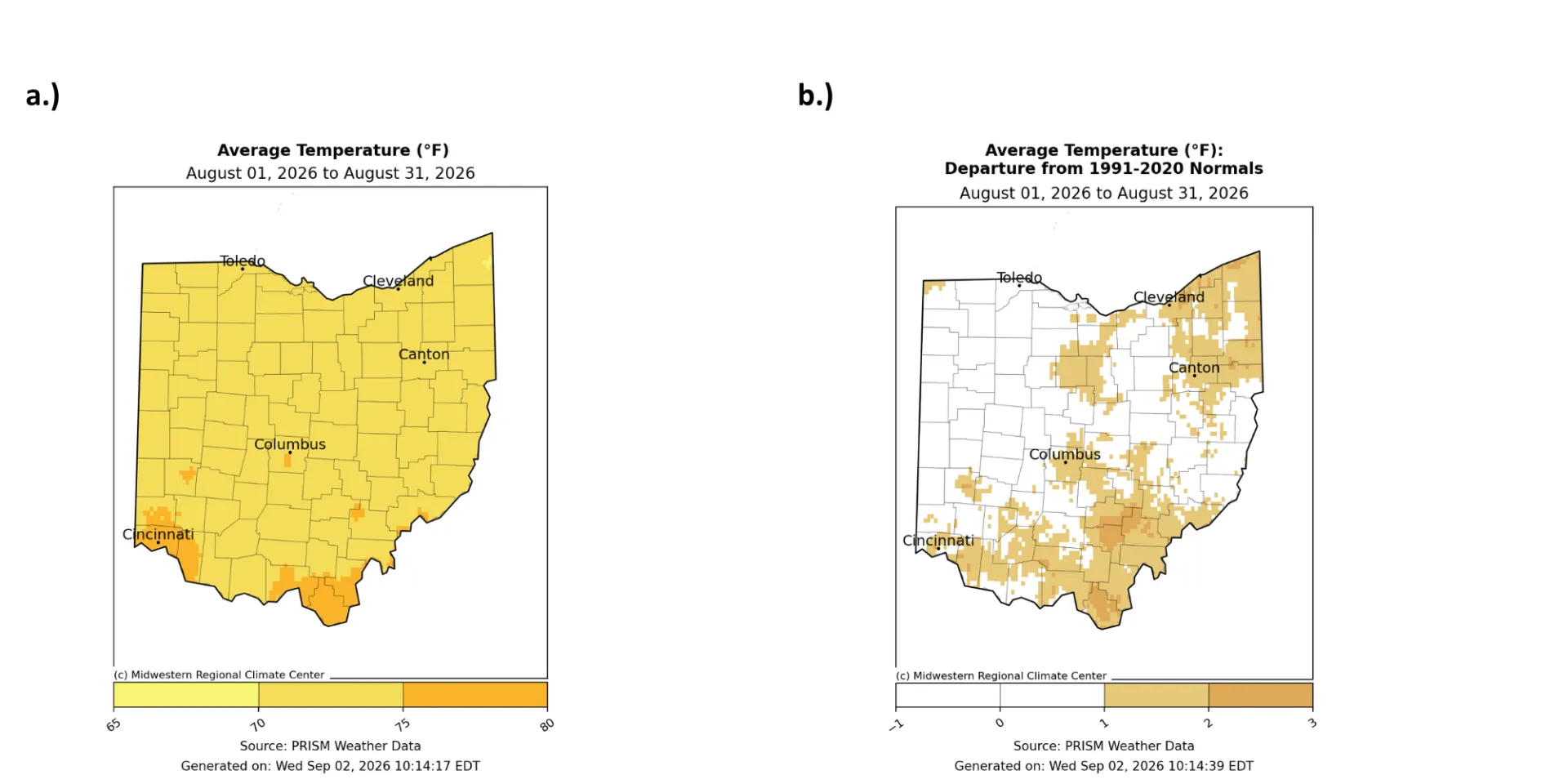
August temperatures held steady in the low 70s across most of Ohio. Cincinnati and the far southern portion of the state were warmer, with average temperatures reaching the upper 70s. A small area in northeast Ohio even dipped into the upper 60s for the month (Fig. 1a). Overall, southern, central, and northeast Ohio ran about 1–2°F above normal, while the rest of the state remained near normal (Fig. 1b).
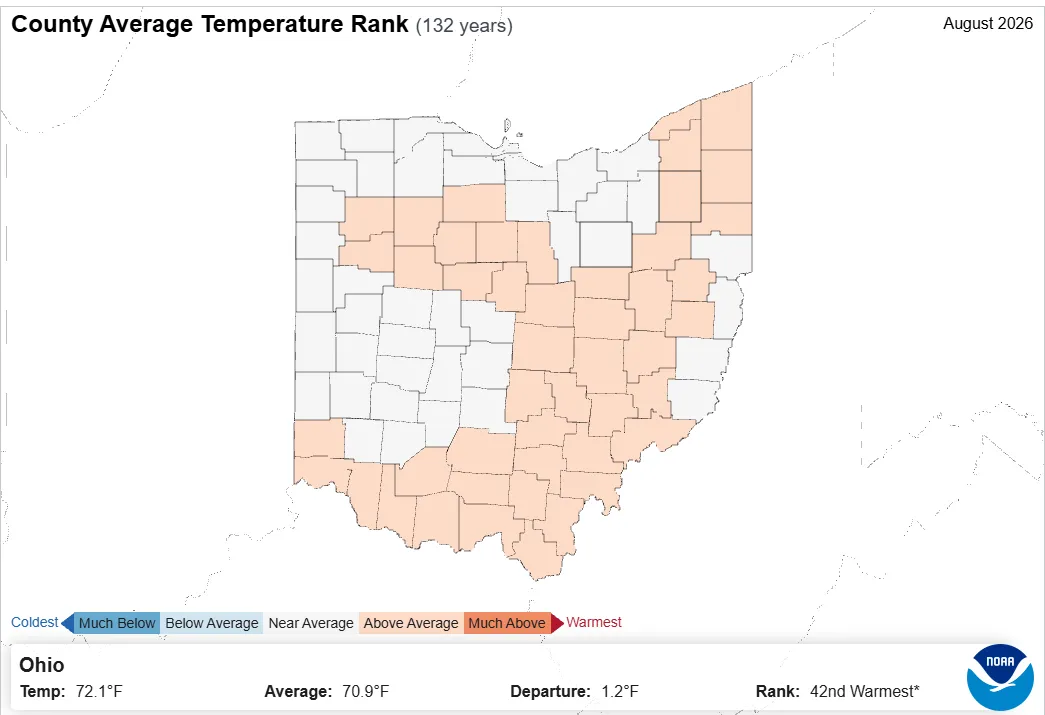
Approximately half of the counties in Ohio were above average, with the remaining half near average. The statewide average temperature comes out to 72.1°F, which is 1.2°F above average, leaving this month for Ohio the 42nd warmest (Fig. 2). Consistent thunderstorm activity helped to keep temperatures from getting too warm in many places.
Precipitation
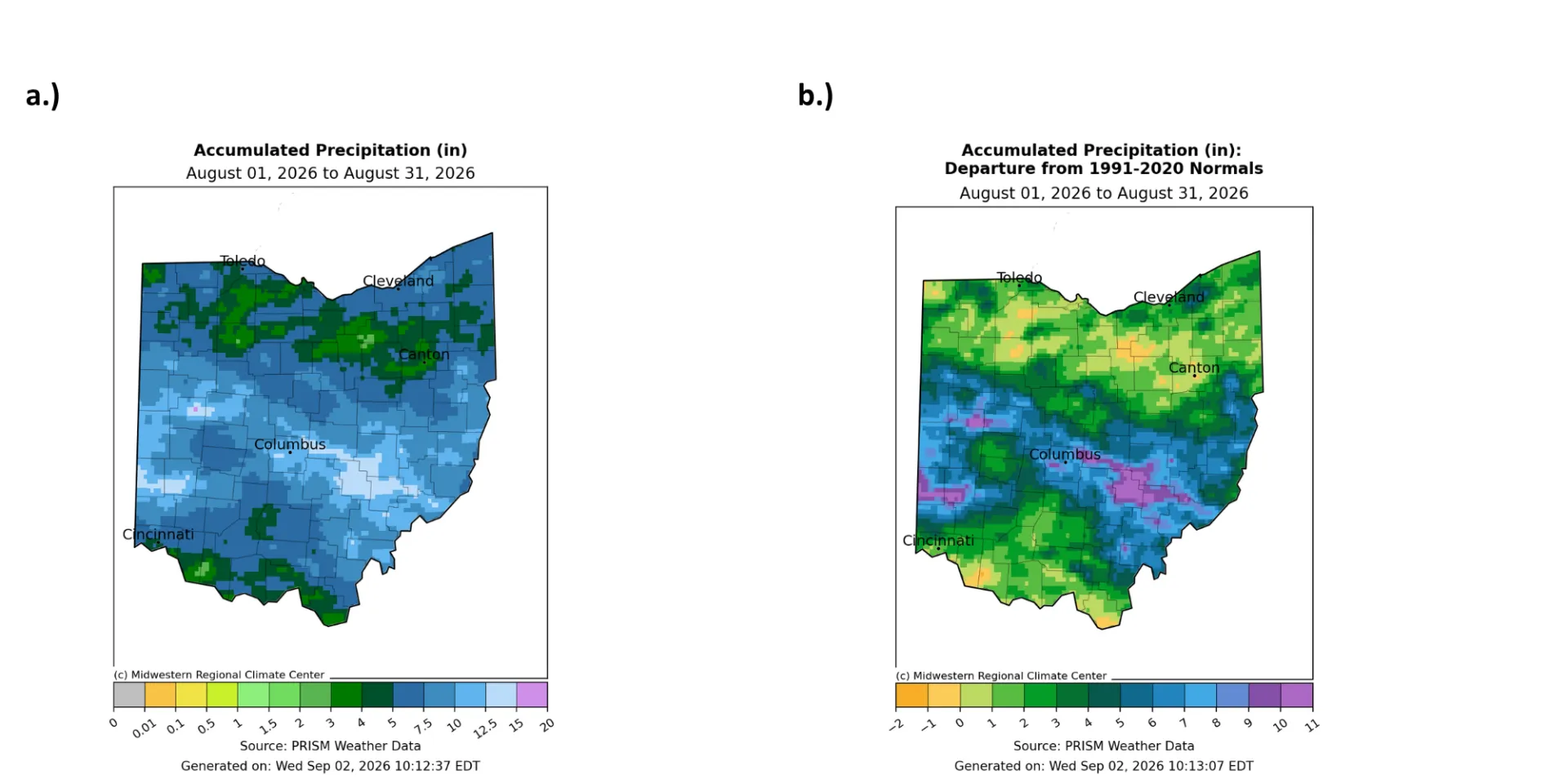
With multiple flooding and severe weather events occurring throughout the month, it’s no surprise that accumulated precipitation reached 12.5–15 inches in some areas. The highest totals stretched from west-central Ohio through southeast Ohio, where monthly rainfall ranged from 7.5 to 15 inches. Outside this corridor, precipitation generally fell between 2 and 7.5 inches (Fig. 3a). This same diagonal band across the state also stood out in the departure-from-normal map, with totals running 10–11 inches above normal. A few smaller pockets in northern and southern Ohio saw 1–2 inches below normal, while the rest of the state was near or above normal (Fig. 3b).
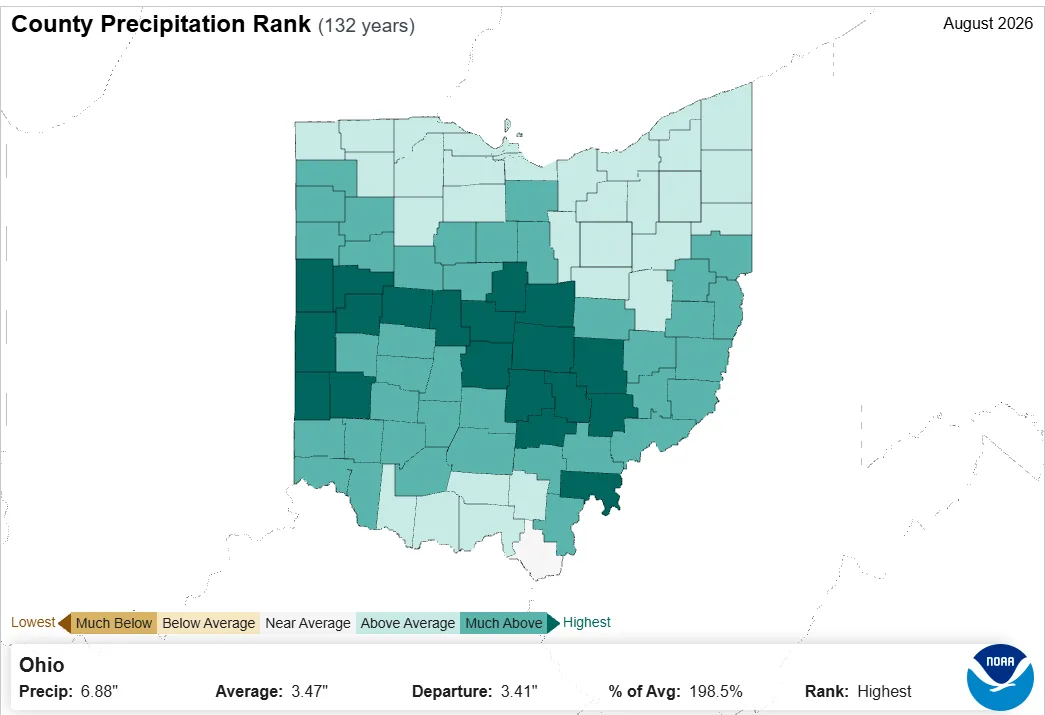
This August marks the highest statewide precipitation recorded for the month. The state averaged 6.88 inches of precipitation, which is 3.41 inches above normal, an astounding 198.5% of the typical monthly value. The greatest rainfall totals were concentrated across central and western Ohio, where many counties experienced much-above-average to record-breaking precipitation (Fig. 4).
Soil & Energy
Soil moisture conditions in August left the west-to-southeast corridor of Ohio in excellent shape. Both topsoil and subsoil in this region were above normal, reaching the 50th–70th percentile. Elsewhere, topsoil conditions in northern and southern Ohio were near normal or 20–30% below normal, indicating drier soils (Fig. 5a). As severe weather diminished and temperatures rose toward the end of the month, the upper 6 inches of soil began to dry out. Subsoil moisture has not yet fallen into the upper 20%-below-normal range and is currently hovering around 0–10% below normal, but with continued warm temperatures, further declines in soil moisture are likely (Fig. 5b).
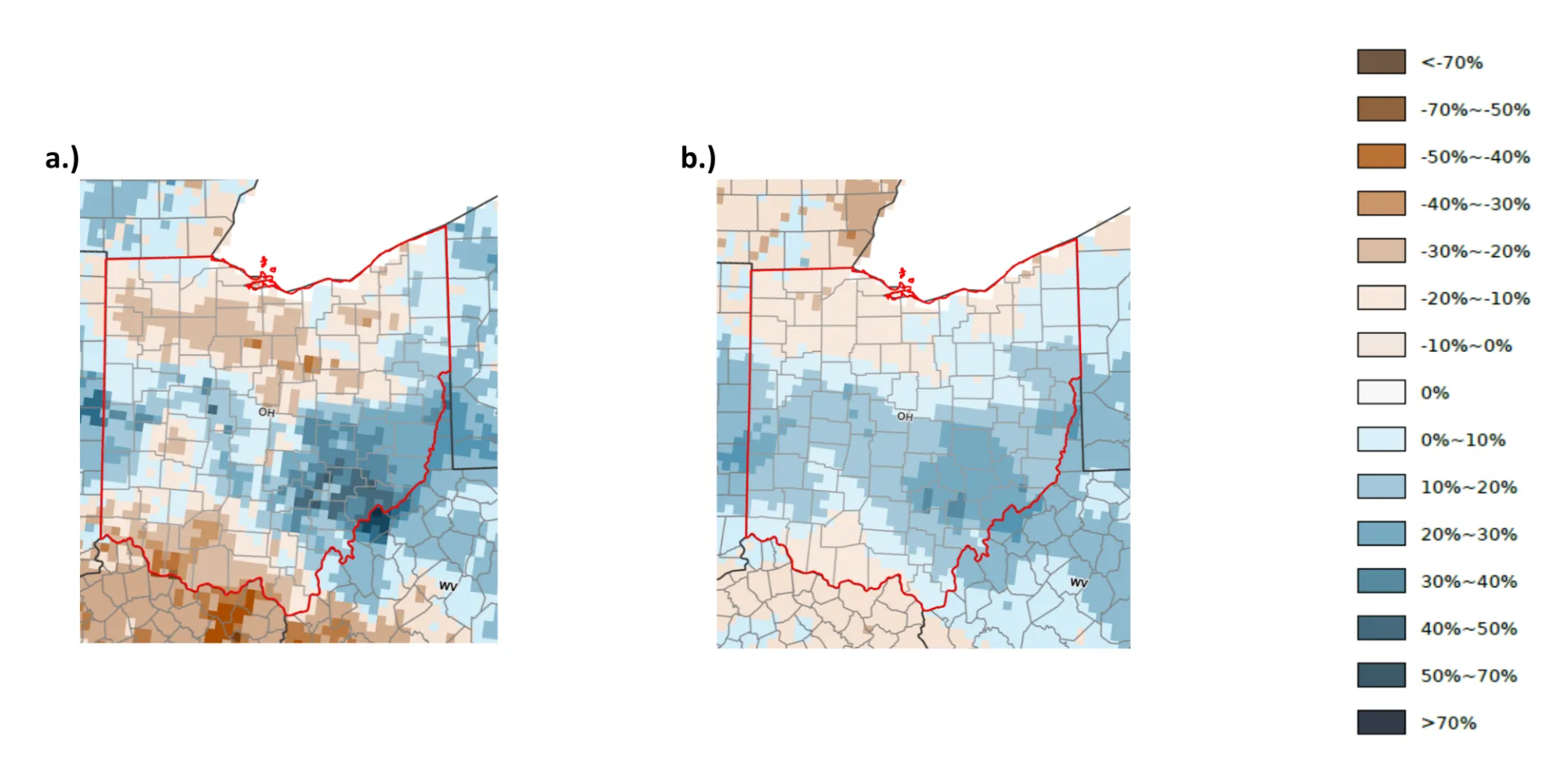
Product Note: Both NASA SPoRT LIS soil moisture products contain small pockets of inaccurate data indicating extremely wet or dry conditions. These small-scale errors can emerge in remote sensing products covering large areas or grid-spacings. For more information, please contact Geddy Davis (davis.5694@osu.edu).
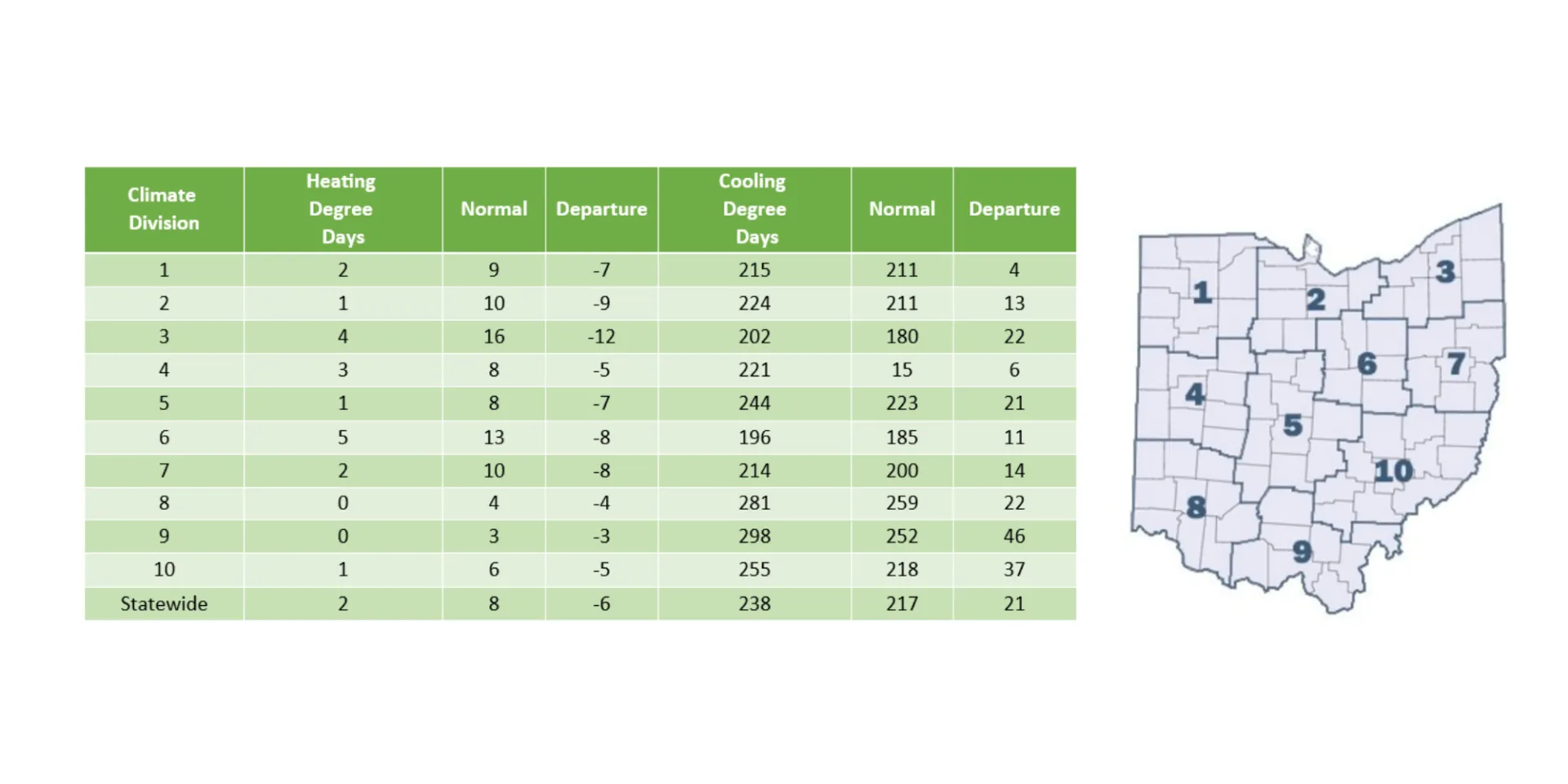
August’s Heating and Cooling Degree Days (HDDs and CDDs) stayed near average. HDDs came in 6 below normal, suggesting that less energy was required for heating. CDDs, however, were 21 above normal, highlighting a noticeably elevated demand for cooling throughout the month (Fig. 6).
Notable Event
August began with an active start, as a cluster of smaller tornadoes impacted southwestern Ohio on the 1st. The more significant event, however, unfolded on August 11, 2026, when two rounds of storms swept through the Ohio Valley and produced 14 rated tornadoes in less than eight hours. The outbreak included 6 EF0s, 7 EF1s, and 1 EF2 (Fig. 7).
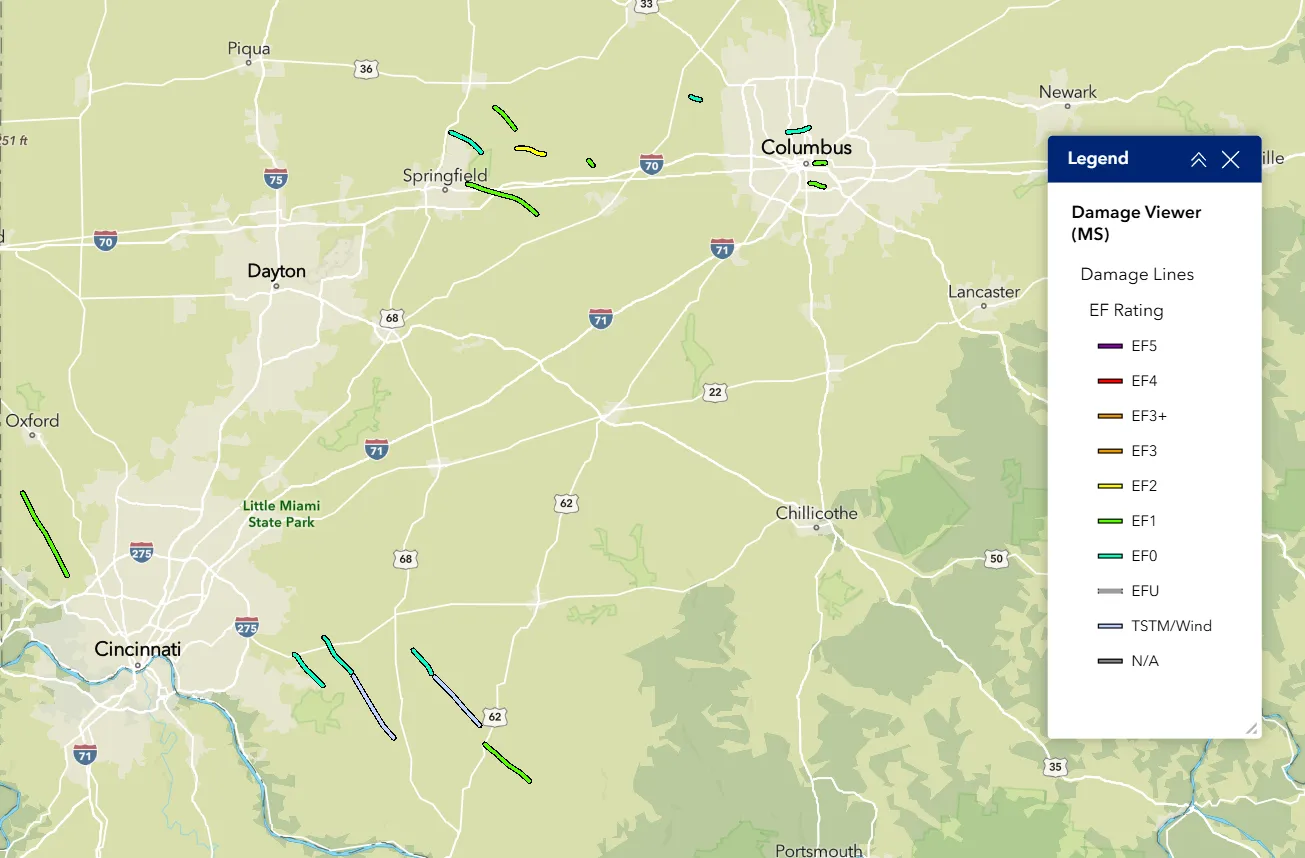
Originating in Indiana, the system developed early in the morning and intensified after sunrise. The timing was particularly notable: peak rush-hour traffic was underway, contributing to the viral video of a car flipping on I-71 and prompting widespread speculation that a tornado had just passed through. Fortunately, no fatalities occurred. Although many of these tornadoes were only on the ground for a few minutes, the damage was widespread, leading to multiple road closures. Straight-line winds and significant flooding also occurred across Columbus. The strongest winds were recorded at John Glenn International Airport (KCMH), where peak gusts reached 82 mph. Figures 8 and 9 highlight damage near OSU’s campus, where an EF0 tornado was later confirmed after photo and video evidence suggested the presence of a tornado and not just straight-line winds.
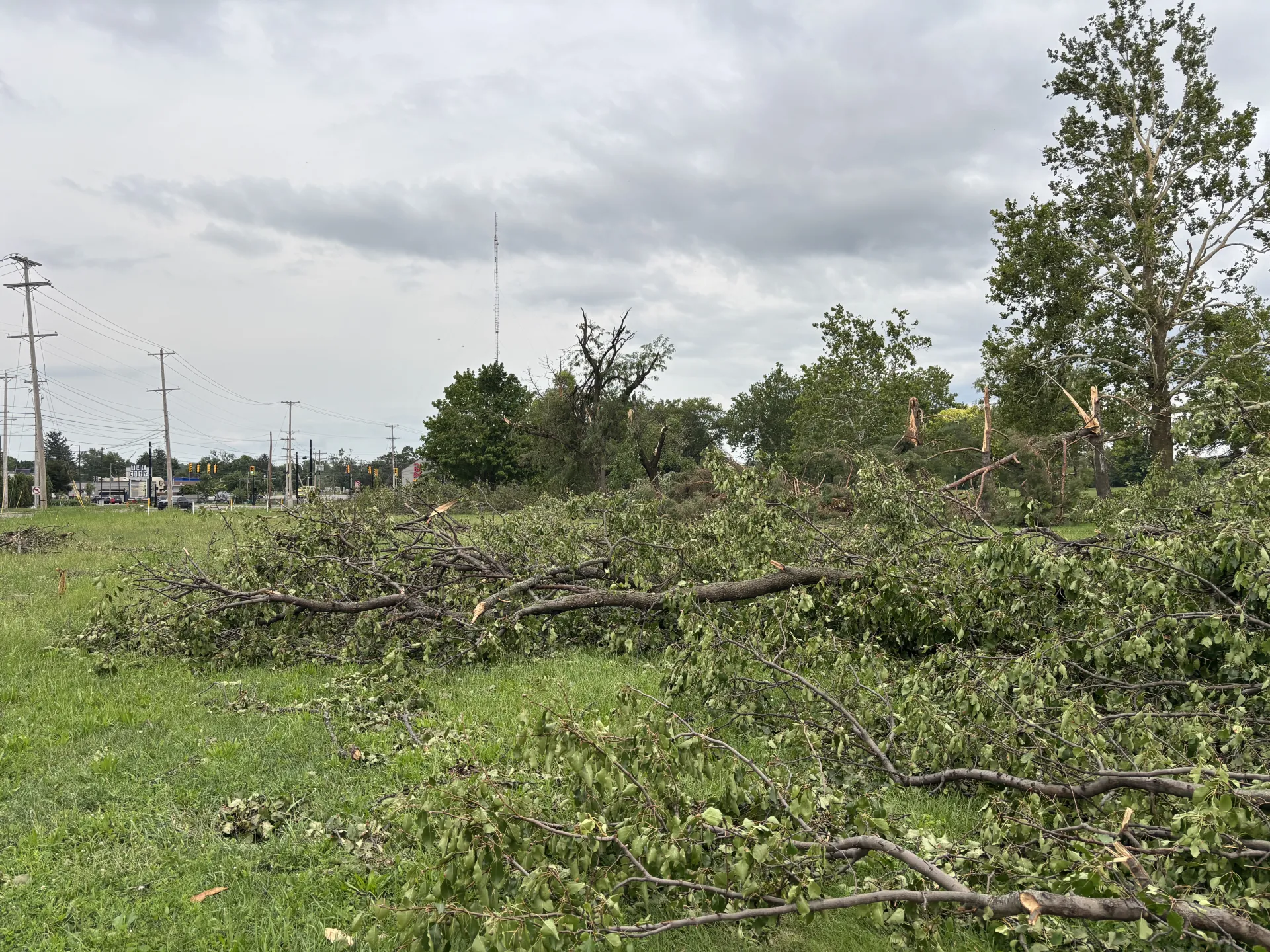
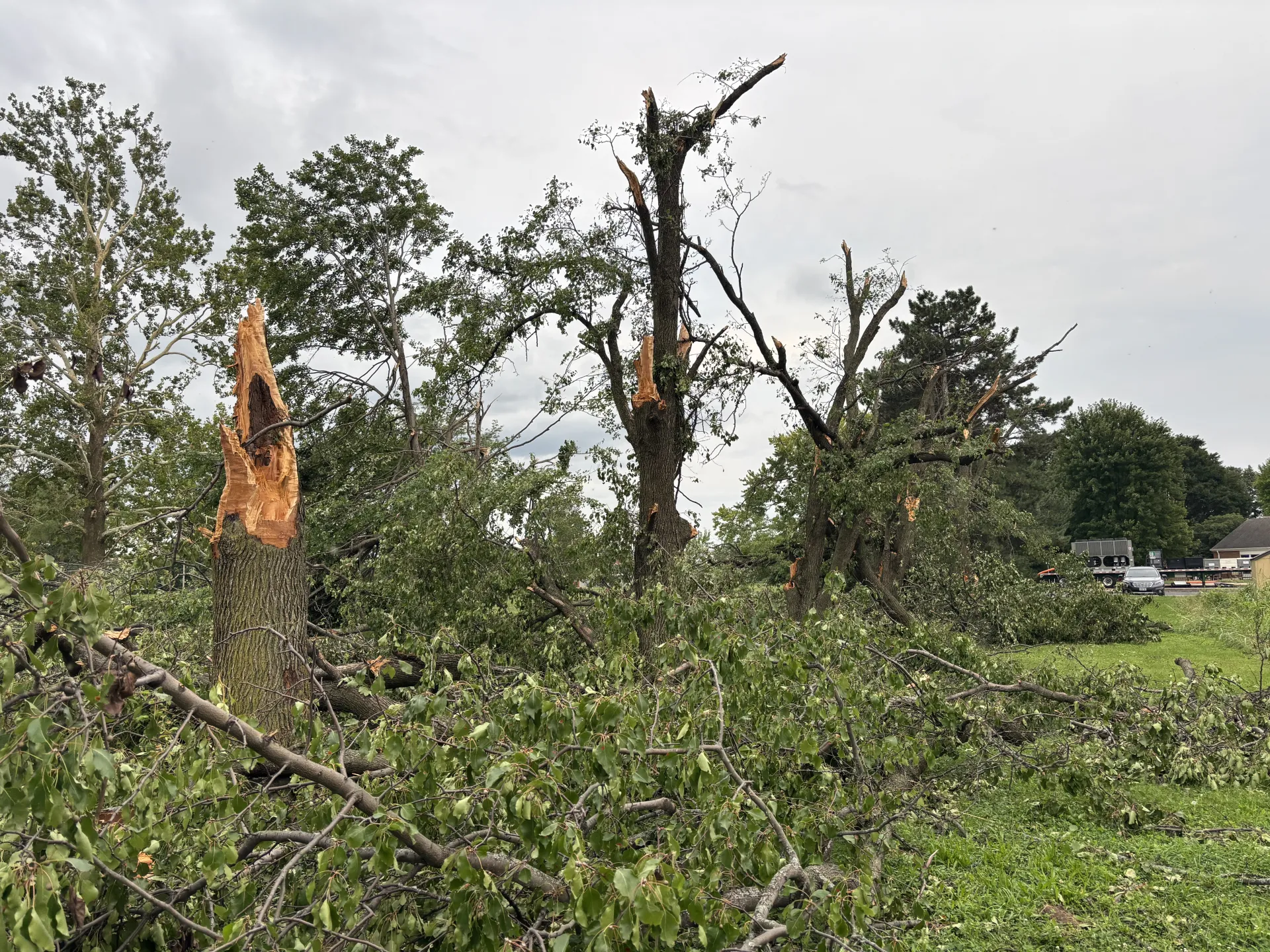
Not pictured are the numerous homes affected by fallen trees and vehicles damaged by flying debris, including shattered windshields from wind-carried branches. Together, these events underscore how even brief, lower-end tornadoes and strong straight-line winds can produce substantial impacts across densely populated urban areas.
Severe weather did not end after the August 11 outbreak; in fact, it returned quickly on August 19-20 with heavy rainfall, followed by flash flood warnings the next day as another round of intense precipitation moved through the region. By the afternoon of August 20, rainfall totals in Central Ohio ranged between 3 and 6 inches, with a max of 6.13 inches south of New Albany (Fig. 10).

Attention shifted to Buckeye Lake and nearby locations, as the water table remained elevated from the August 11 event and flooding concerns grew. On the morning of August 21, the South Fork of the Licking River set a new crest record at 882.9 feet, causing significant flooding along I-70 and State Route 70. Both roadways were closed, and a mandatory evacuation was issued for residents west of SR-79 (Fig. 11).
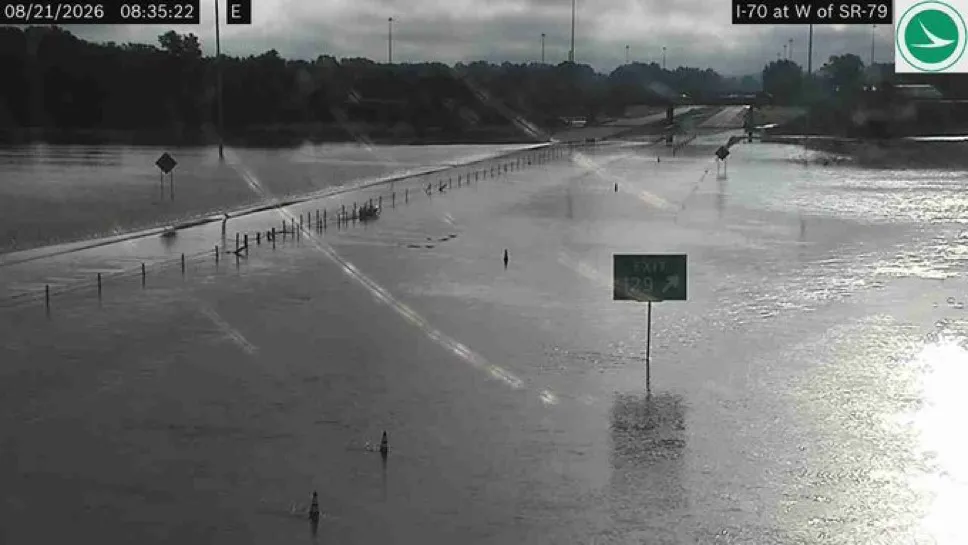
Flooding continued to affect central Ohio, leaving parks, trails, and smaller green spaces hazardous for all individuals. Due to repeated heavy rainfall events, staggering monthly rainfall totals were observed in numerous locations. One example was Zanesville, OH, where 10.77 inches of rain was recorded, marking the wettest month of August there since 1896 (Fig. 12).
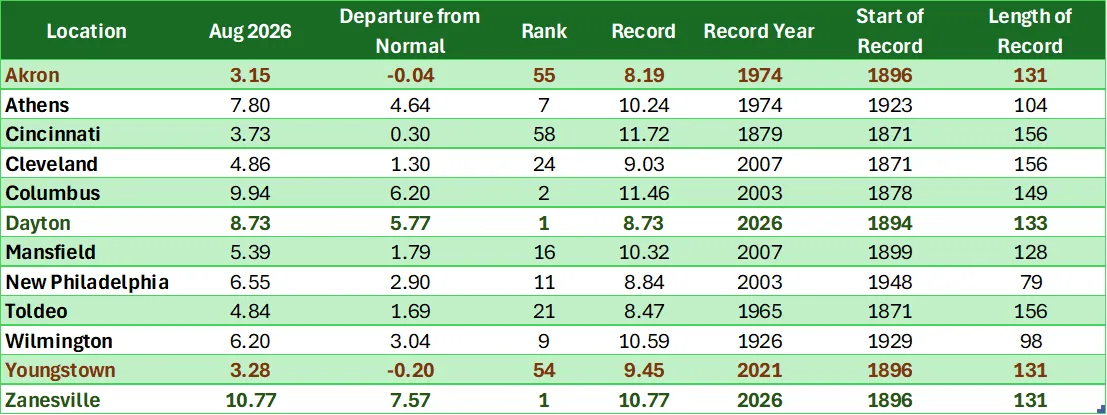
Together, these back-to-back events highlight how saturated ground conditions and repeated heavy rainfall can rapidly escalate into widespread, high-impact flooding across central Ohio. Flooding events of this magnitude are extremely dangerous and must be taken seriously; avoid walking, biking, or driving through moving water.
Looking Ahead
Over the next three months, both temperature and precipitation outlooks show a largely uncertain pattern, with equal chances for warmer or cooler and wetter or drier conditions across most of Ohio. The only exception is a narrow area in northeast Ohio, which has a slight tilt toward above-normal temperatures (Fig. 9a). Precipitation follows a similar pattern: nearly the entire state has equal chances of above- or below-normal totals, while northeast Ohio shows a modestly increased likelihood of drier conditions (Fig. 9b).
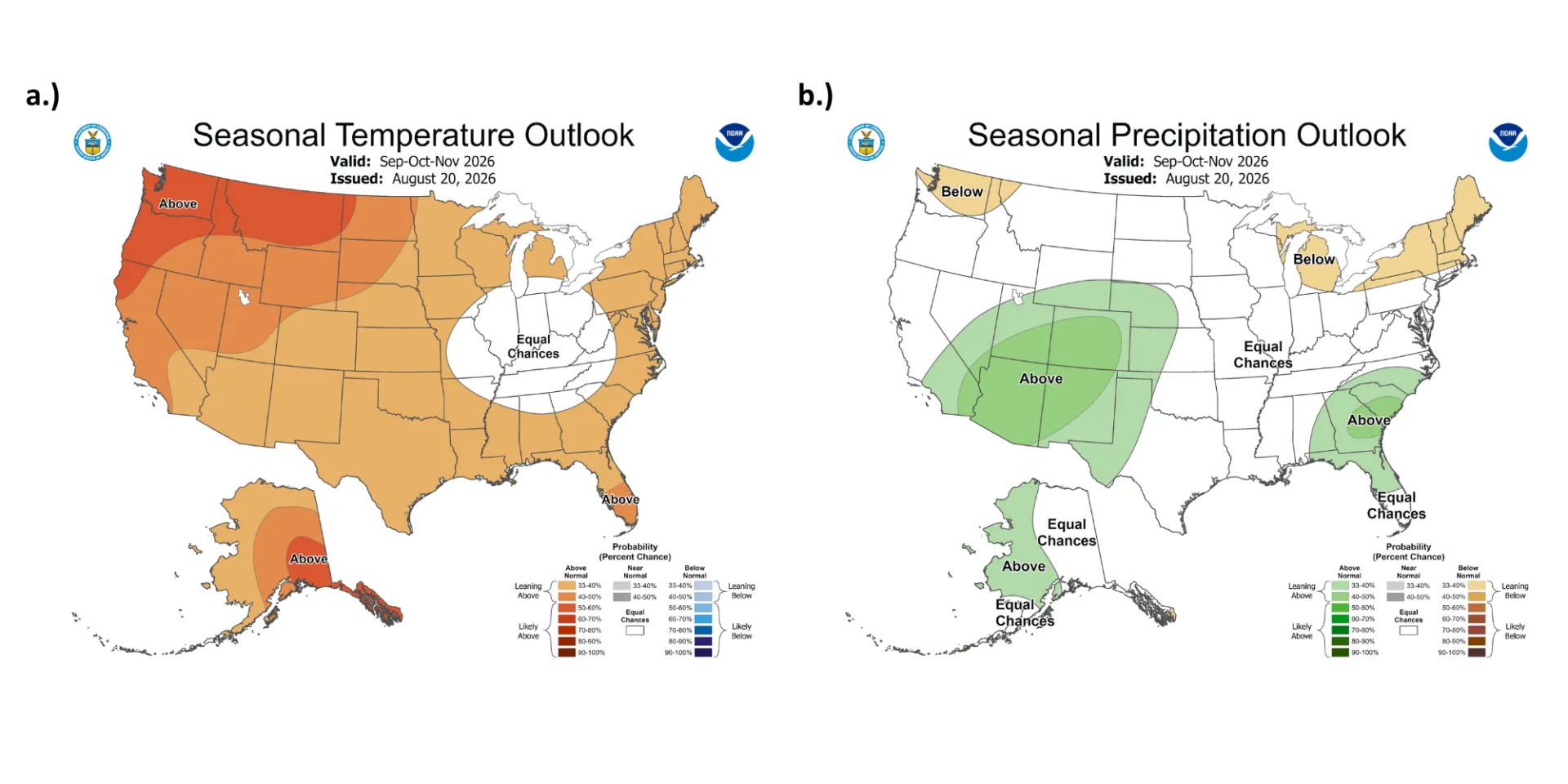
Despite the above-normal rainfall, crops continue to stay ahead of the growth curve. Corn, in particular, is tracking well above the five-year average 1 . Because most of Ohio’s crops have reached advanced maturity, the recent heavy rainfall poses minimal structural risk. Early-season flooding is far more damaging, when young seeds and seedlings can easily wash out. Note: these outlooks do not provide the quantity of above- or below-normal conditions, just the likelihood of occurrence (i.e., the probability).
1. Ohio Crop Progress Report, August 31st, 2026. Ohio’s Country Journal.
Authors
Alexis Jahnke: Undergraduate Student, Student Assistant: Climate Services, Byrd Polar and Climate Research Center, The Ohio State University, jahnke.30@osu.edu
Geddy R. Davis: Meteorologist/Atmospheric Scientist, Program Coordinator: Climate Services - Byrd Polar and Climate Research Center, The Ohio State University, davis.5694@osu.edu
Aaron B. Wilson: State Climate Office of Ohio, Byrd Polar and Climate Research Center & OSU Extension, The Ohio State University, wilson.1010@osu.edu